


In celebration of the Pentecostal Messenger's 100th volume, we review the early foundations and legacy of this important publication.
Spencer Ming
August 20, 2026
Topic:
Pentecostal History
In December 1919, ministers from six states and Canada gathered in a building on South Halsted Street in Chicago to pray and commit themselves to spreading the Gospel. By the end of the meeting, a new Movement had been formed—The Pentecostal Assemblies of the U.S.A. (which would eventually become the Pentecostal Church of God). The meeting had been called through a publication, and the man who was chosen to serve as its secretary was the publication's editor. Among the founding resolutions of that historic gathering, written into the original covenant was this: that the new movement would exist, in part, “to publish, sell and distribute Christian literature and papers.” Before the Pentecostal Church of God had a formal headquarters, doctrinal statement, leadership team, or budget, it had access to a press.
Before there was a Pentecostal Messenger there was The Pentecostal Herald, which was launched in 1915 by George C. Brinkman of Chicago. By 1918, The Herald reported an annual circulation of 550,000, making it arguably the most widely read Pentecostal periodical in the country. The founding convention formally resolved that The Herald had grown “perhaps three times as large as any other Pentecostal paper in the field.” Its stated purpose carried a particular boldness: “taking the Gospel to those outside of Pentecost.” At first, this was not a newsletter designed for the already convinced; it was a Pentecostal proclamation aimed toward a world that had not yet heard. When the founding convention formally recognized the Pentecostal Herald as the “official organ” of the Pentecostal Assemblies of the U.S.A. (first documented in print on the headline of the February 1920 issue), they were declaring that the movement and the magazine would be united in mission and purpose.
The founders had reasons to lean this way. The early twentieth-century Pentecostal revival had spread largely through the printed page. Frank Bartleman broke news of the Azusa revival through a holiness paper. Regional and national periodicals carried testimonies, revival reports, and missionary dispatches from city to city, filling the gap that slow travel and poor communication could not. Early Pentecostals understood, perhaps better than most, that the Gospel travels through every available channel. While we may be wrestling with the efficacy of Christian communication through social media and artificial intelligence today, PCG founding fathers resolved in their very first convention that “aggressive evangelism” be the movement's motto. In doing so, they reflected a conviction that cutting-edge communications technology should be utilized to advance the Kingdom and impact eternity. 100 years ago, the Pentecostal Herald became a tool to do just that, and today, the Pentecostal Messenger remains committed to communicating the same calling and commission by any means necessary.
In 1927, a transition occurred as General Secretary Alpha D. McClure and his wife, Violet, pioneered a relocation effort, moving the national office from Chicago, Illinois to Ottumwa, Iowa. At the same time, they launched a new publication to carry the movement's voice: the Pentecostal Messenger. Notably, the first assets the organization secured in that transition were not properties or furnishings but printing equipment. Furthermore, when the headquarters building was erected, though it was but just a frame “hut,” the signage above the door read, “The Pentecostal Messenger, Office of Pentecostal Church of God.” Again, notice the sequence: before the PCG had a permanent address, it insisted upon the power of the press.
The McClures gave the early Messenger its character. They were evangelists and church builders who had founded the Ottumwa congregation with $84 and grown it until they had to add a balcony. During the Great Depression, they ran a soup kitchen and trekked through winter storms to make sure their congregation ate. The magazine they launched carried that same “aggressive” evangelistic approach as The Herald had prior, portraying radical generosity, being outward-facing, and committing itself to those who had not yet heard the Gospel. In fact, the name of the publication itself carried a theology, since a messenger is one who actively proclaims good news to those who need it.
When the national office moved to Kansas City, Missouri (1933), The Messenger followed. During this era of PCG history, the printing operation steadily grew to the point where the publishing house began producing its own discipleship literature. By 1949, subscription to the Pentecostal Messenger was formally embedded in the required minister assessment. That action made a powerful statement and formally marked a significant shift in the target audience: the magazine and the ministry were now largely inseparable, and every credentialed minister would receive it.
In 1951, the PCG settled in Joplin, Missouri, where it remained for sixty years. Ferrell Semler became the first officially designated full-time editor in the early Joplin years and held the position until 1973. In 1958, the magazine moved from a weekly newspaper format to a monthly periodical, and over the following decade, from letterpress to offset. By 1969, the Pentecostal Messenger circulated to approximately 9,000 individuals, churches, and homes. At this time, Messenger Publishing House, the magazine's institutional home, was producing well over a million pieces of literature annually, with The Messenger remaining as the flagship communications resource for a growing global movement.
The Joplin era also deepened the connection between the Pentecostal Messenger and the movement's top leadership. General Superintendent R. Dennis Heard, who led the PCG from 1953 to 1975, took a personal interest in every publication the house produced and contributed regularly. He carried the conviction that the magazine was a primary ministry of the movement and a critical communications opportunity for executive leadership. Though not explicitly related, it is interesting that Superintendent Heard's conviction was later codified in 2011, when the General Convention amended the PCG Bylaws to formally designate the General Bishop as Editor in Chief of the Pentecostal Messenger.
What the magazine provided across those decades was harder to measure than circulation figures. In every era, The Messenger connected a scattered fellowship to something larger than its own local church. It carried testimonies from six continents, reported from the mission field, and gave a movement of independent and often isolated churches a way to see themselves as one. It chronicled what God had done and pointed toward what God intended to do next. Regardless of time and location, those two things together, memory and mission, have become The Messenger's foundational contribution to the Pentecostal Church of God. Because of its consistency and longevity, the Pentecostal Messenger is undoubtedly this movement's most important source of institutional knowledge, serving as a record of spiritual breakthrough and an archive of ministerial life and legacy.
In the most recent era leading up to and following the PCG's relocation to Bedford, Texas (2011), the magazine entered a season of intentional redesign and restructure, earning recognition from the Evangelical Press Association (2009, 2014, 2020, 2024) for refining both its design and editorial voice.
During this same period, The Messenger's publication frequency and distribution model both changed. Over time, the magazine moved from monthly production to a quarterly calendar (2012) and then eventually settled on a trimester schedule (2019). In 2021, production officially shifted toward digital distribution. While the Pentecostal Messenger is still printed in smaller quantities for subscribers, digital priority opens the door for a renewed emphasis on utilization of cutting-edge communications technologies. Now, for the first time, many articles, images, and stories originally published in the Pentecostal Messenger are also shared to a global audience through the PCG's online resource database as well as the PCG social media and email networks.
100 years ago A.D. and Violet McClure sat down at a press in Ottumwa, believing that putting words on paper might help spark a movement that could reach the whole world with the Gospel. Today, the Pentecostal Messenger plays an important role in helping the PCG connect, resource, and witness as one church in 6000+ locations. This magazine represents 107 years of a tradition that operates with conviction to utilize communications technology for the purpose of “aggressive evangelism” and “taking the Gospel to those outside Pentecost.” From the founding charter of this movement, through five headquarter cities, across several dozen editorial hands, and amidst multiple generations, the Pentecostal Messenger has carried one movement forward with one mission.
Pages have turned. Chapters have closed. But new stories have yet to be written, and the press is still printing.
Want to ask a question, tell a story, or share what you've learned? Let us know!
Connect with our Team
Looking back on the history of the Pentecostal Messenger with editors Charlotte Beal, John Mallinak, Randy Lawrence Jr., and Spencer Ming.
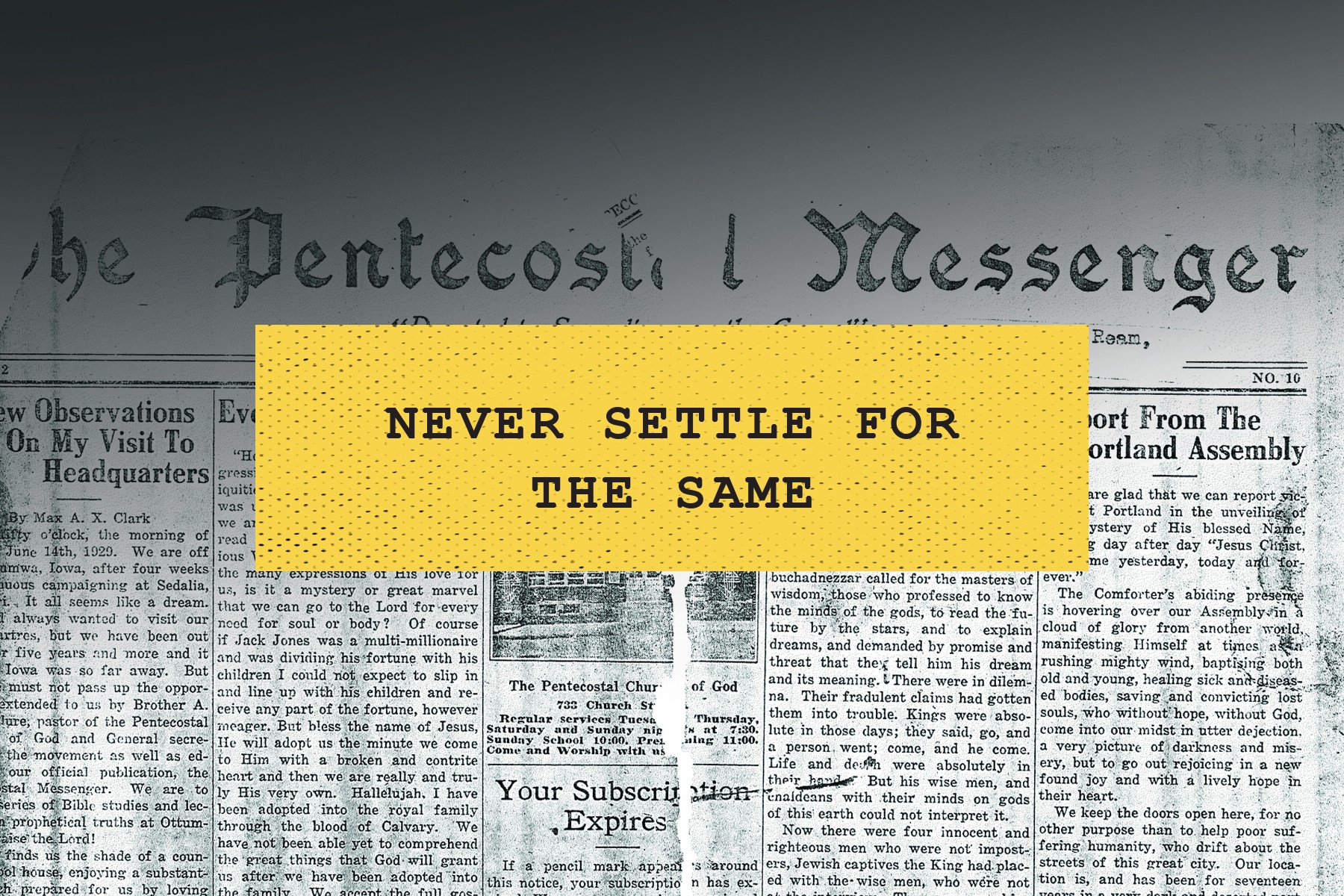
After 100 volumes of the Pentecostal Messenger, we pause to review significant changes in form and style through each decade of the magazine's existence.
General Bishop Virgil Kincaid pictures the PCG as one symphony movement with many parts under one Conductor, all moving together toward a crescendo.

© 2025 Pentecostal Church of God. All rights reserved.


